Juggle
Making The Job Search More Fun! (Dashboard Design, Using AI for UED Case Study)
Making The Job Search More Fun! (Dashboard Design, Using AI for UED Case Study)
Making The Job Search More Fun! (Dashboard Design, Using AI for UED Case Study)
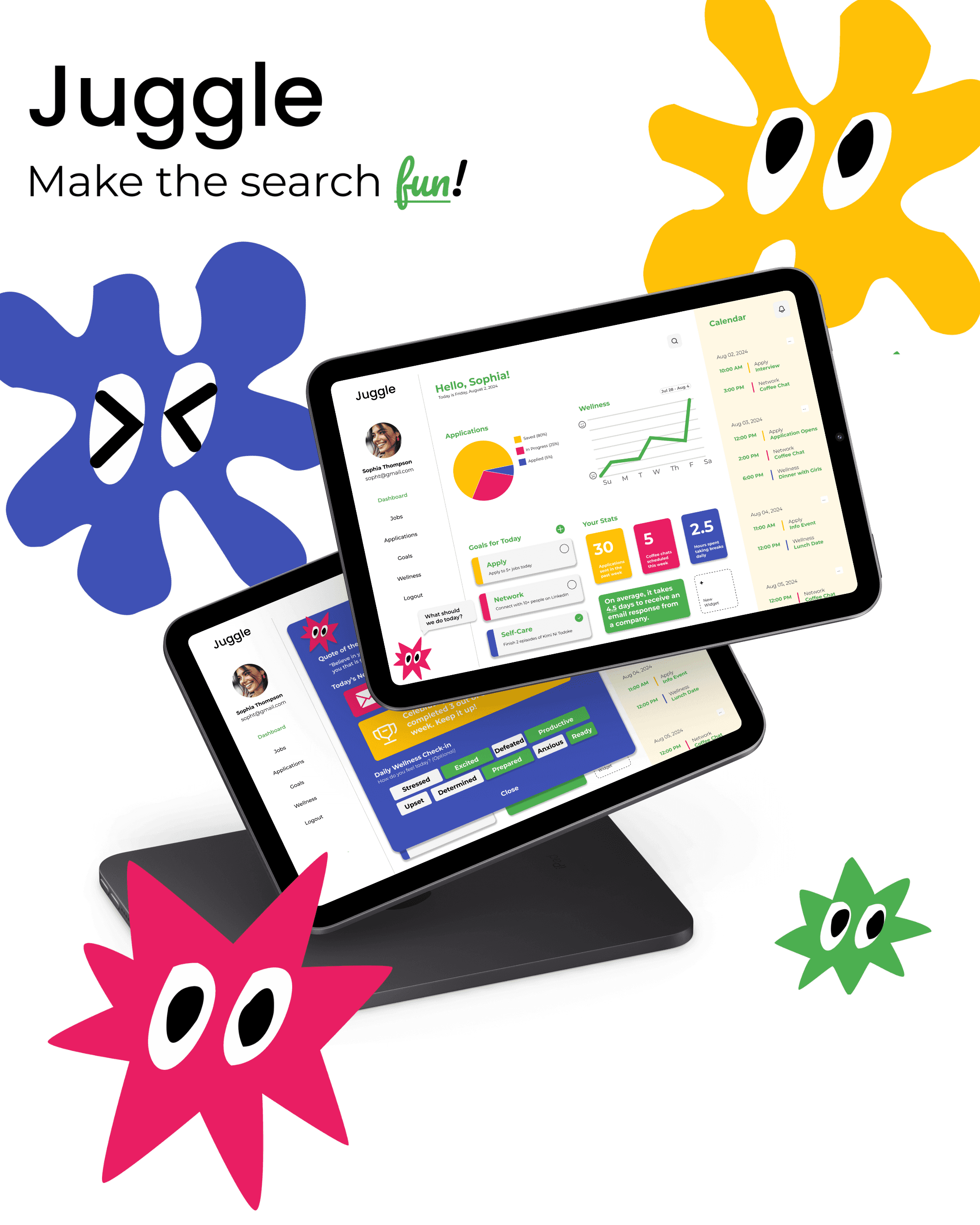
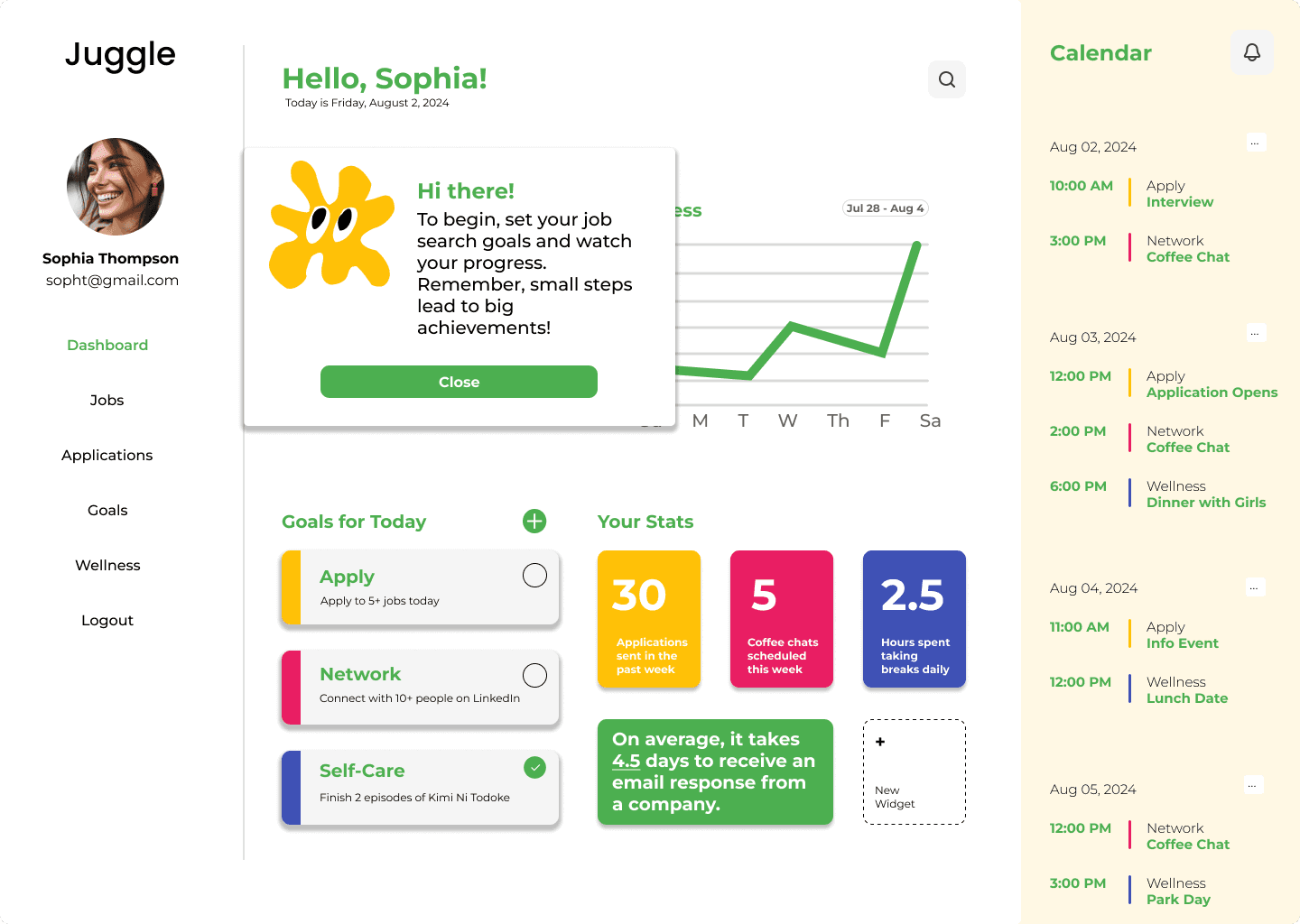
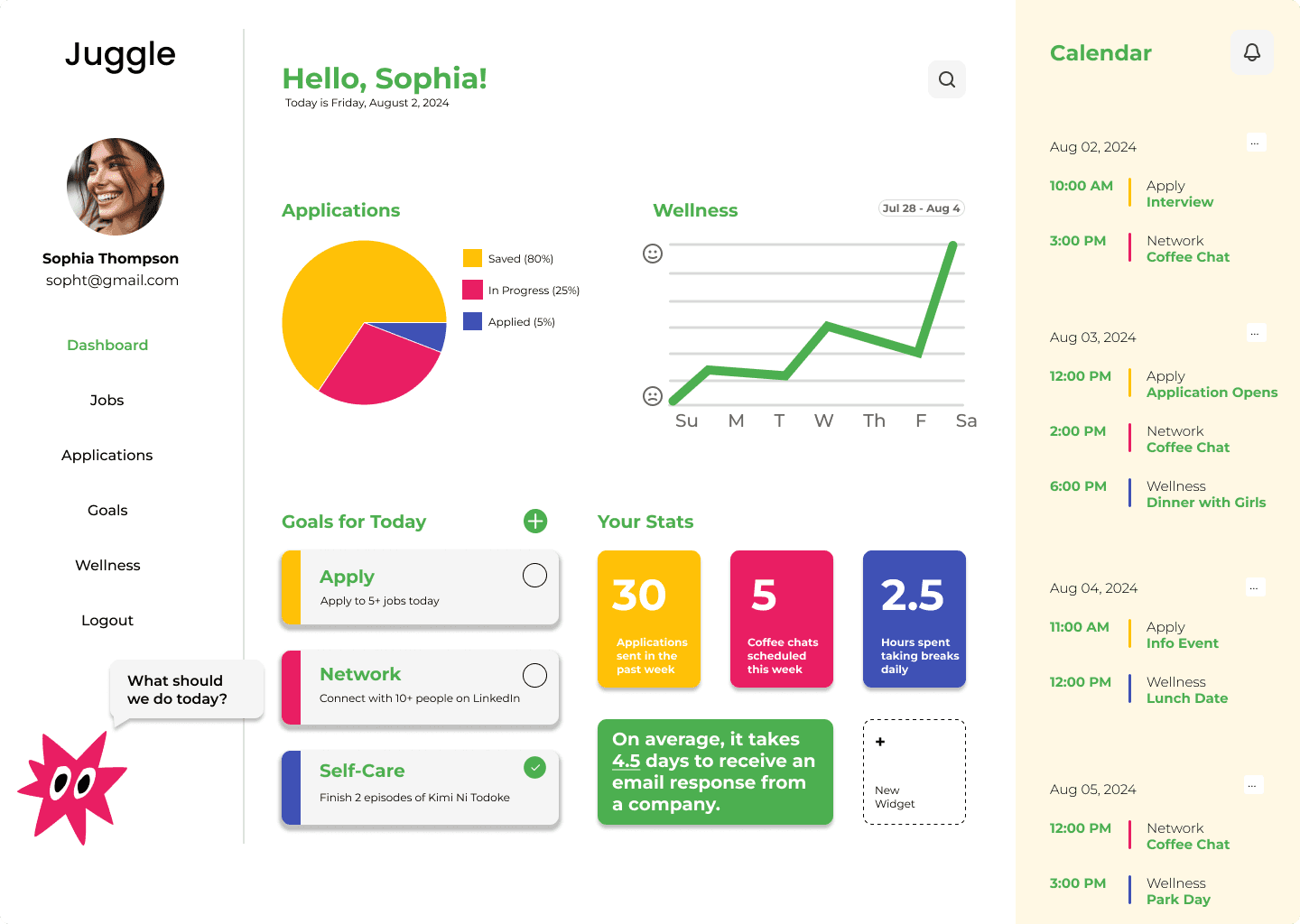
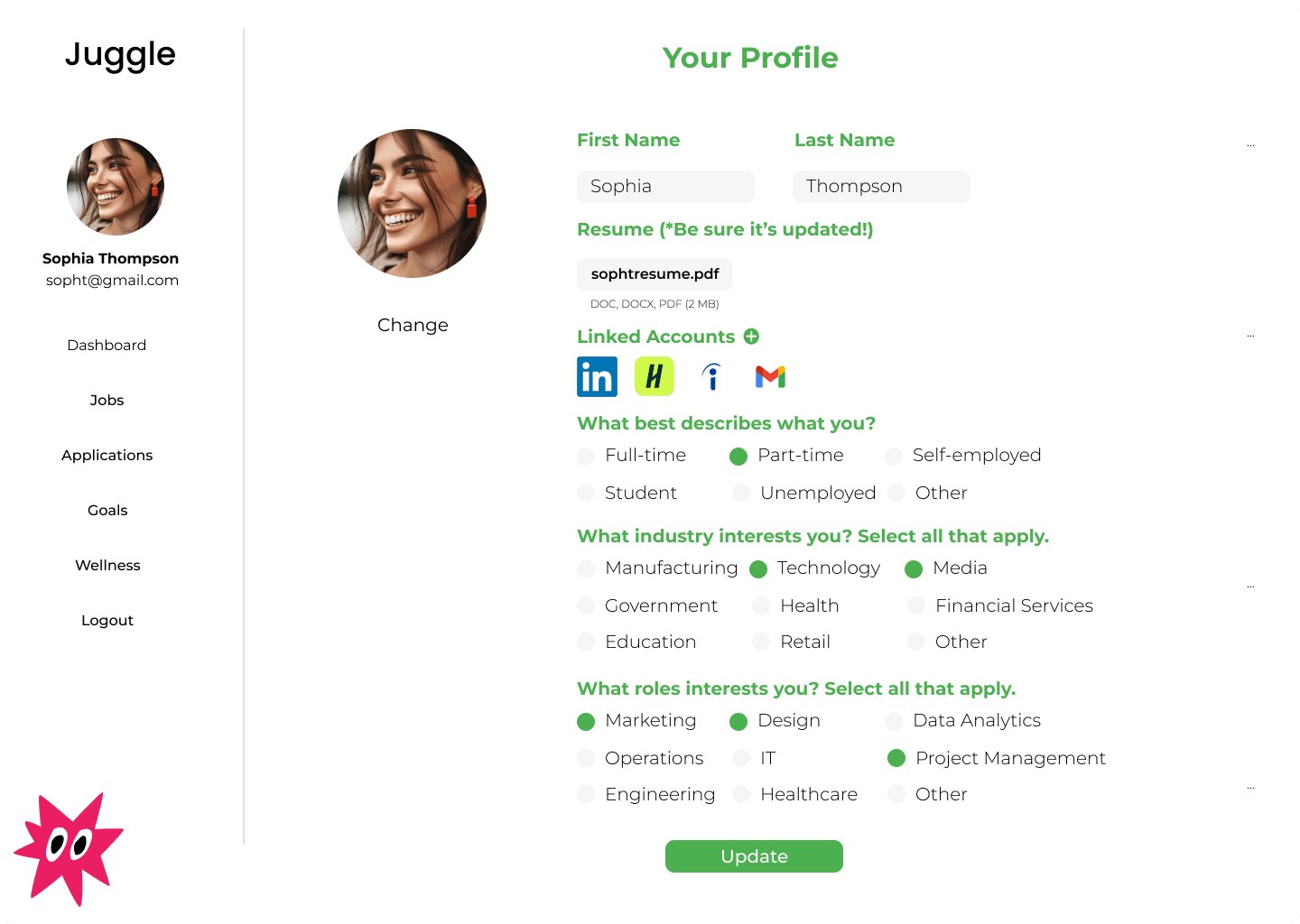
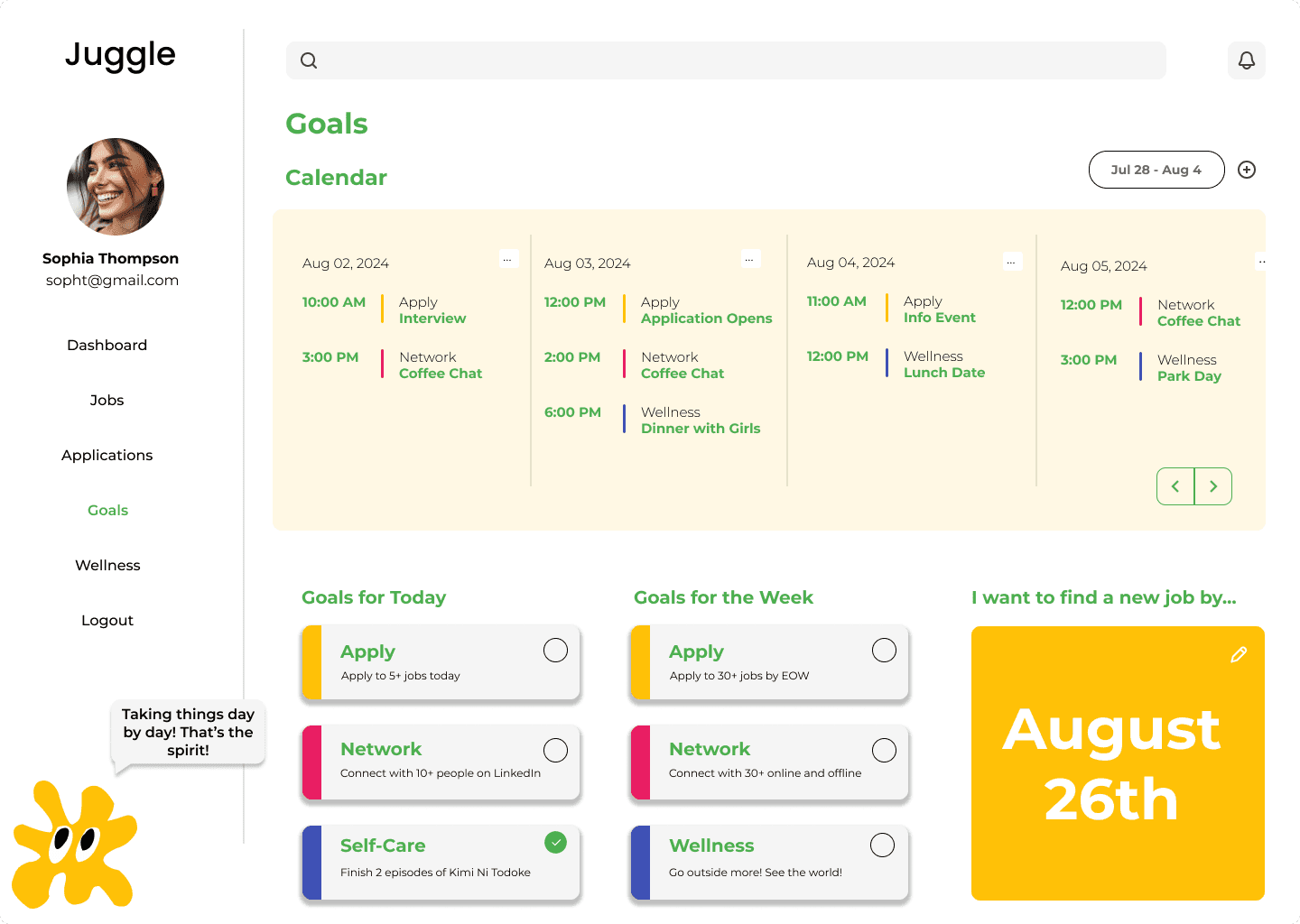
Juggle is a collaborative user dashboard that helps early career job hunters track their job application activity, goals, and tasks.
MY ROLE
UI/UX Designer, Research, Ideation, and Prototyping
PROJECT
SCOPE
Sole Designer,
2 weeks
TOOLS
ChatGPT,
Miro, Figma,
GoogleMeets,
Adobe Firefly,
Qualtrics,
Procreate
MY ROLE
PROJECT SCOPE
TOOLS
UI/UX Designer, Research, Ideation, and Prototyping
Sole Designer, 2 weeks
ChatGPT, Miro, Figma, GoogleMeets, Adobe Firefly, Qualtrics, Procreate
MY ROLE
UI/UX Designer, Research, Ideation, and Prototyping
PROJECT
SCOPE
Sole Designer,
2 weeks
TOOLS
ChatGPT,
Miro, Figma,
GoogleMeets,
Adobe Firefly,
Qualtrics,
Procreate
Problem
The job search can feel endless, disorganized, and challenging.
Being on the job search myself, it’s difficult to keep up with the hundreds of applications I’ve sent over the past few months. Speaking with fellow peers in the early stages of their career who have either been in the job search, have recently ended their job search, or are a few months into a new job, regardless of stage, there is a consensus that it's just tough. People are feeling defeated, lost, or overwhelmed, especially in this job market. Over time, they start to feel disorganized with application submissions and eventually lose track after having to endlessly switch between hiring platforms.
Focusing on the organization and wellness aspects of applying for jobs, I wanted to design a collaborative user dashboard that helps early career job hunters track their job application activity, goals, and tasks. Some objectives I wanted to keep in mind were to maintain motivation in applying by engaging users in a simple and fun way as well as to tailor the platform to appeal to an early career demographic (ages 18-25 years old) through branding.
On top of that, I also wanted to challenge myself to incorporate using AI throughout the whole design process, skills I learned in a recent course I took through LinkedIn to test my knowledge and determine the efficiency of the research and ideation phases.
As a result, this prompts the question.
Being on the job search myself, it’s difficult to keep up with the hundreds of applications I’ve sent over the past few months. Speaking with fellow peers in the early stages of their career who have either been in the job search, have recently ended their job search, or are a few months into a new job, regardless of stage, there is a consensus that it's just tough. People are feeling defeated, lost, or overwhelmed, especially in this job market. Over time, they start to feel disorganized with application submissions and eventually lose track after having to endlessly switch between hiring platforms.
Focusing on the organization and wellness aspects of applying for jobs, I wanted to design a collaborative user dashboard that helps early career job hunters track their job application activity, goals, and tasks. Some objectives I wanted to keep in mind were to maintain motivation in applying by engaging users in a simple and fun way as well as to tailor the platform to appeal to an early career demographic (ages 18-25 years old) through branding.
On top of that, I also wanted to challenge myself to incorporate using AI throughout the whole design process, skills I learned in a recent course I took through LinkedIn to test my knowledge and determine the efficiency of the research and ideation phases.
As a result, this prompts the question.
Being on the job search myself, it’s difficult to keep up with the hundreds of applications I’ve sent over the past few months. Speaking with fellow peers in the early stages of their career who have either been in the job search, have recently ended their job search, or are a few months into a new job, regardless of stage, there is a consensus that it's just tough. People are feeling defeated, lost, or overwhelmed, especially in this job market. Over time, they start to feel disorganized with application submissions and eventually lose track after having to endlessly switch between hiring platforms.
Focusing on the organization and wellness aspects of applying for jobs, I wanted to design a collaborative user dashboard that helps early career job hunters track their job application activity, goals, and tasks. Some objectives I wanted to keep in mind were to maintain motivation in applying by engaging users in a simple and fun way as well as to tailor the platform to appeal to an early career demographic (ages 18-25 years old) through branding.
On top of that, I also wanted to challenge myself to incorporate using AI throughout the whole design process, skills I learned in a recent course I took through LinkedIn to test my knowledge and determine the efficiency of the research and ideation phases.
As a result, this prompts the question.
How Might We…
Alleviate the stress and challenges that comes with applying for jobs?
Validating Assumptions
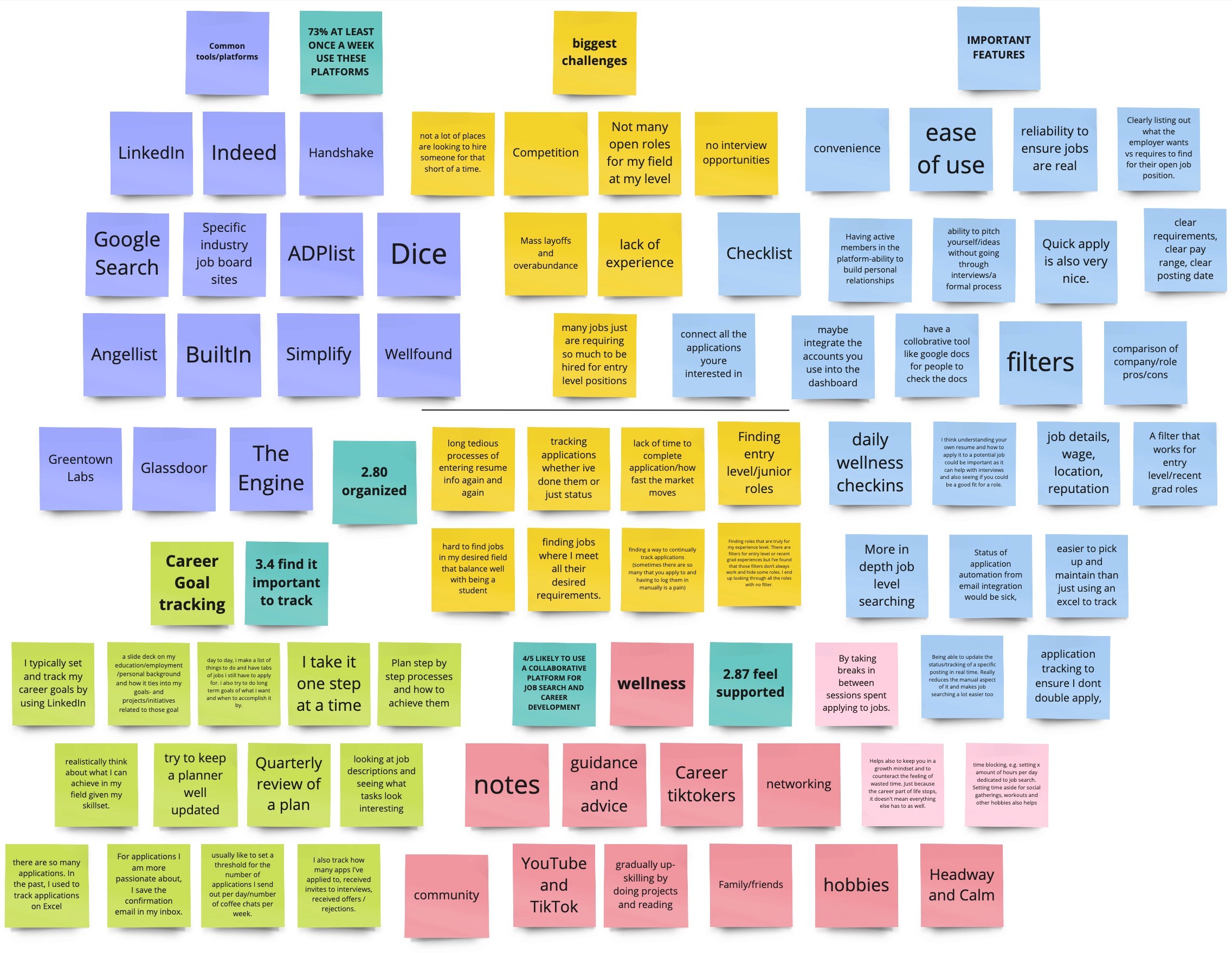
Beginning the research with firsthand experience and conversations with fellow jobseekers, I dived deeper into these challenges by conducting primary and secondary research. Using ChatGPT, I prompted the tool to provide me with examples of interview questions to assess the pain points and user goals for my design idea. After 2 rounds of refinement, the results were 10 questions consisting of 4 open-ended, 5 rating scales, as well as 2 specific feature questions. Interviewing 15 participants ages 18-25 years old with diverse backgrounds of employment status and degrees of education presented common insights that further validated the assuming obstacles with searching for a job. To better understand these findings, I categorized answers under topics such as common job search platforms, biggest challenges for job hunters, career goal tracking, important features of these platforms, and wellness.
Insights gathered from interviews.
Some major pain points participants highlighted throughout these interviews were…
"A lack of time to complete applications with how fast the market moves."
"Manually logging in every single application and finding a way to continually track them afterwards."
"Having to end up looking through roles without a filter because while there are filters for entry-level or recent grad experiences, they often are unreliable and actually hide some roles."
"A lack of time to complete applications with how fast the market moves."
"Manually logging in every single application and finding a way to continually track them afterwards."
"Having to end up looking through roles without a filter because while there are filters for entry-level or recent grad experiences, they often are unreliable and actually hide some roles."
"A lack of time to complete applications with how fast the market moves."
"Manually logging in every single application and finding a way to continually track them afterwards."
"Having to end up looking through roles without a filter because while there are filters for entry-level or recent grad experiences, they often are unreliable and actually hide some roles."
Moving onto secondary research, I further investigated the pain points of these fresh early career job seekers in the 2024 job market using ChatGPT, which revealed that currently, the job market is highly competitive, as graduates are facing uncertainty and instability in job availability and many entry-level jobs still require some level of experience. As a result, this creates a catch-22 situation, with many finding internships, volunteer work, and part-time jobs during college to be crucial to overcoming these barriers. In addition, the pressure to secure a job quickly can lead to significant stress and anxiety among new graduates. Furthermore, 56.7% of job seekers use referrals from friends and acquaintances, indicating the importance of personal connections in the job search. However, 75.4% of candidates utilize LinkedIn, followed by other online job boards (67%) and company websites (64%) to find a job, which shows a heavier reliance on digital platforms for job hunting.
These overall findings through both primary and secondary research convey the crucial need for a platform that eases the hunt in a way that reduces disorganization and acknowledges the anxiety of the experience.
Competitor Analysis
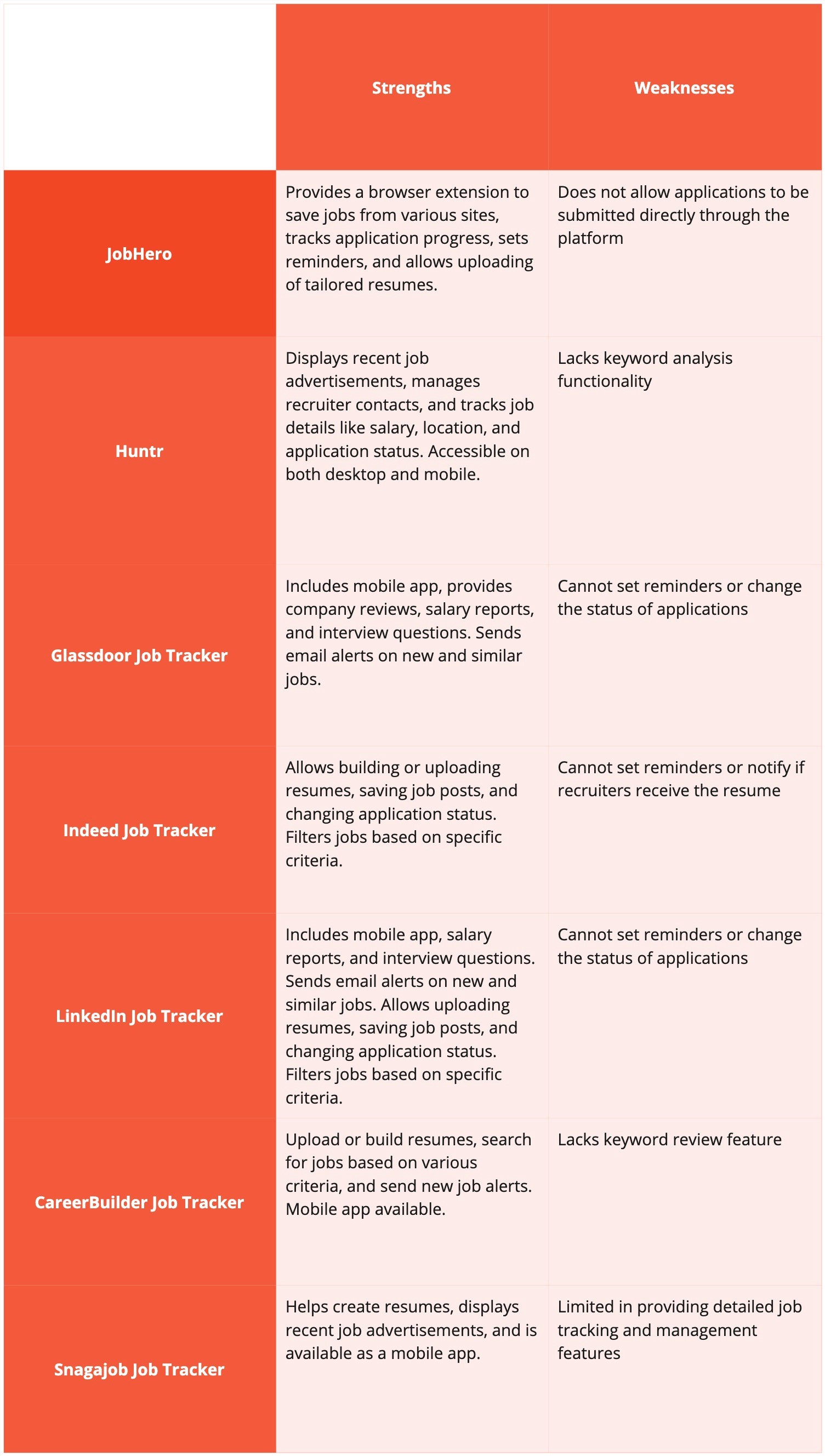
To better understand the job application tracking space, I used AI to help me compare the strengths and weaknesses between several popular platforms.
Comparisons of job application tracking systems.
Overall, these platforms offer various features to help track job applications, manage resumes, set reminders, and provide analytics. However, common weaknesses found were limited customization options, lack of direct application capabilities, and occasional interface usability issues. From this analysis, I made sure to keep these areas of improvement for the various tools in mind when ideating a collaborative user dashboard that focuses on ease of use, comprehensive tracking, and strong integration capabilities.
Defining Customer Personas & Goals
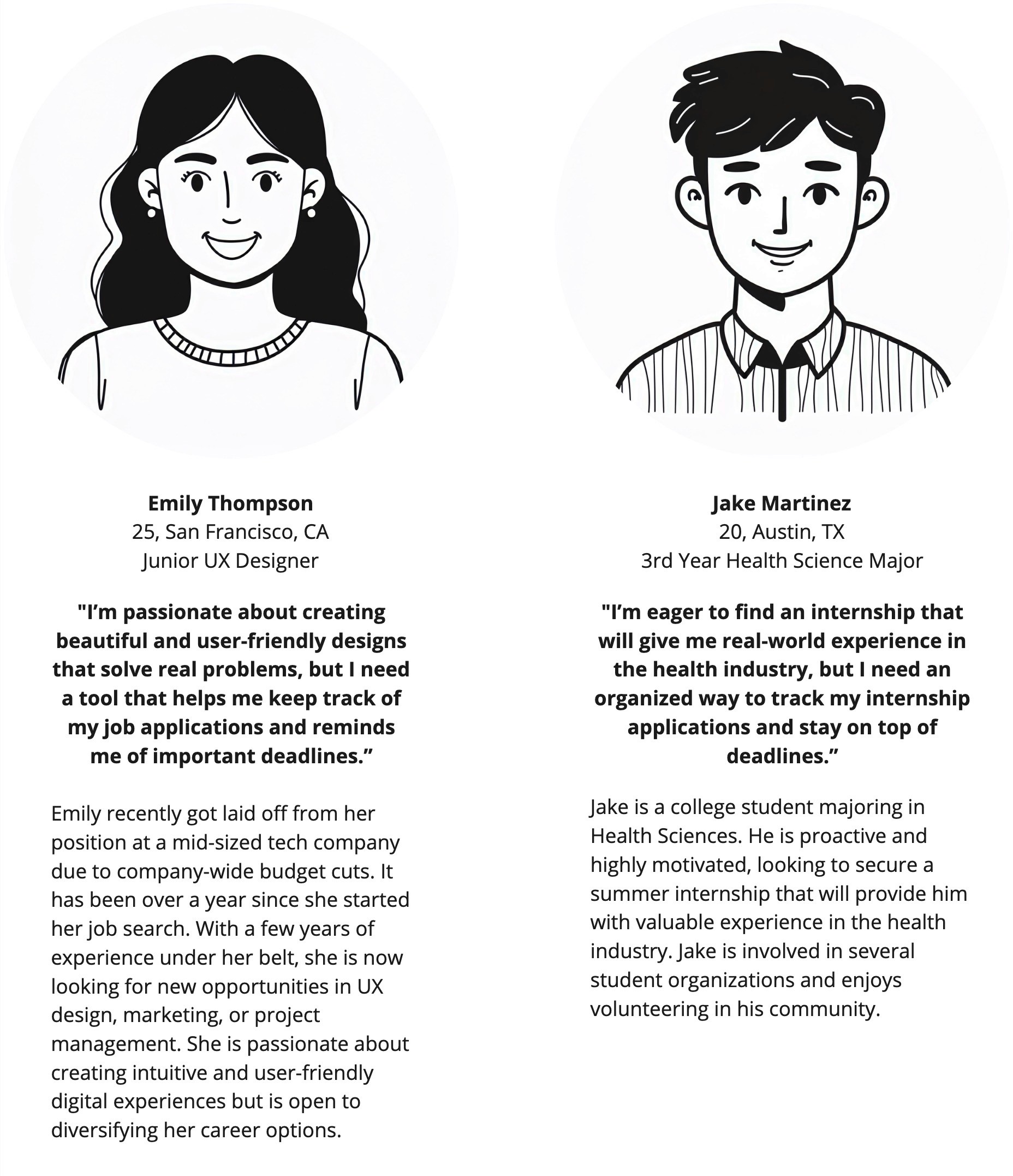
Reflecting our key insights into 2 user personas who currently are on the job hunt, I used Adobe Firefly to generate images of a man and woman with the prompts, “hand-drawn doodle line image of a young woman smiling” and “hand-drawn doodle line image of a young man smiling”, and I prompted ChatGPT to come up with background, goals, challenges, and quotes.
Design Goals
To address all user needs, the ideal solution has to include features the user can utilize throughout the entire process of searching for a job and support them personally and professionally. After three rounds of ideation with ChatGPT, I concluded to focus on three main areas: job search tracking, goal setting, and well-being support. In addition, I want to ensure that the platform includes a collaborative feature to further motivate the user.
Helps users manage multiple applications and deadlines, reducing the stress of keeping track of various stages as well as motivate users by breaking down large goals into manageable tasks and celebrating small wins.
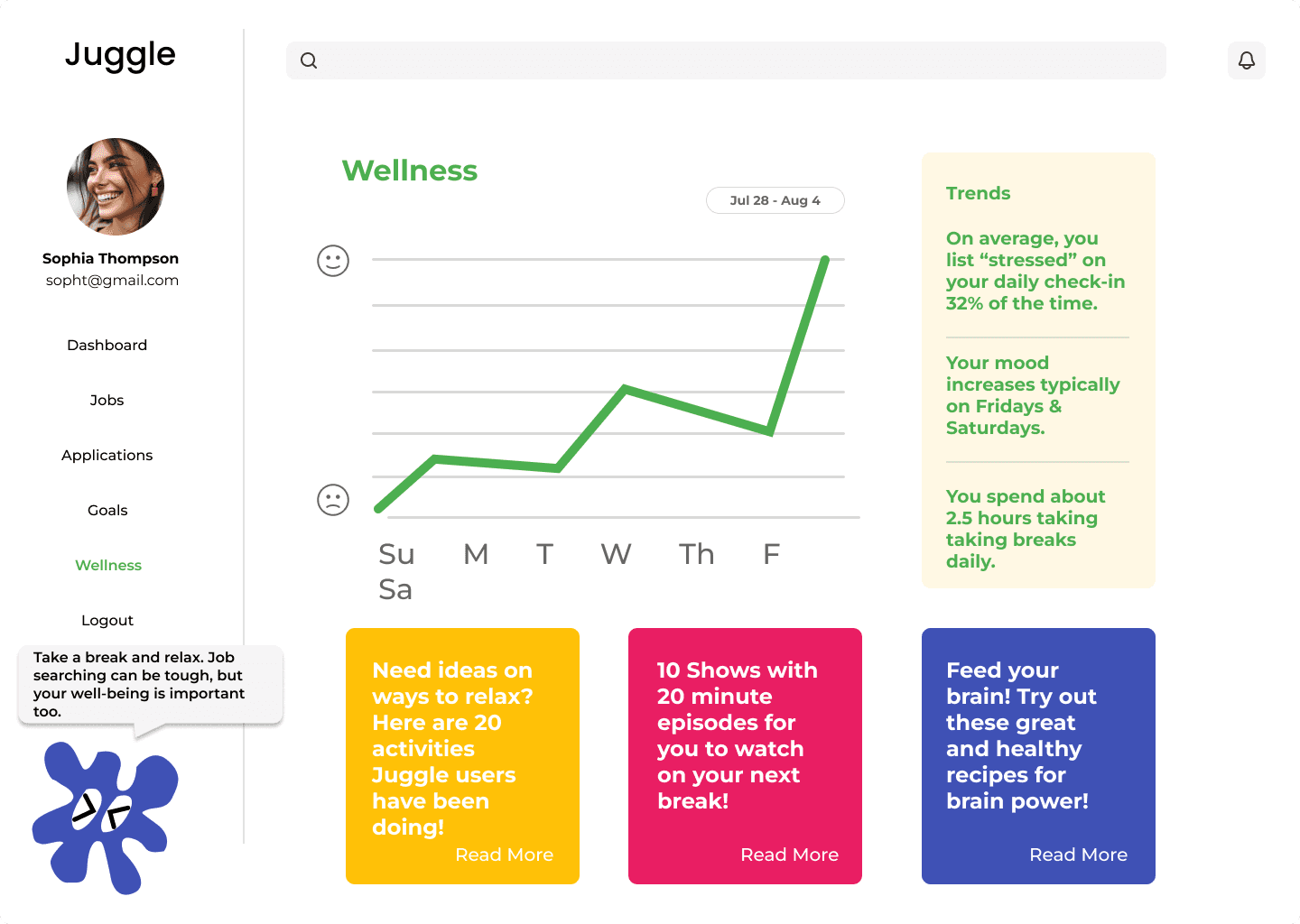
Provides tools to manage stress and maintain mental health, addressing the emotional challenges of job searching.
A personalized experience inspires users to be better informed and maintain interest.
Providing a platform to connect users can support their goals and help them feel less alone in their learning journey.
Implement mechanisms for users to provide feedback on platform features and suggest improvements, ensuring that the dashboard evolves based on user needs and preferences.
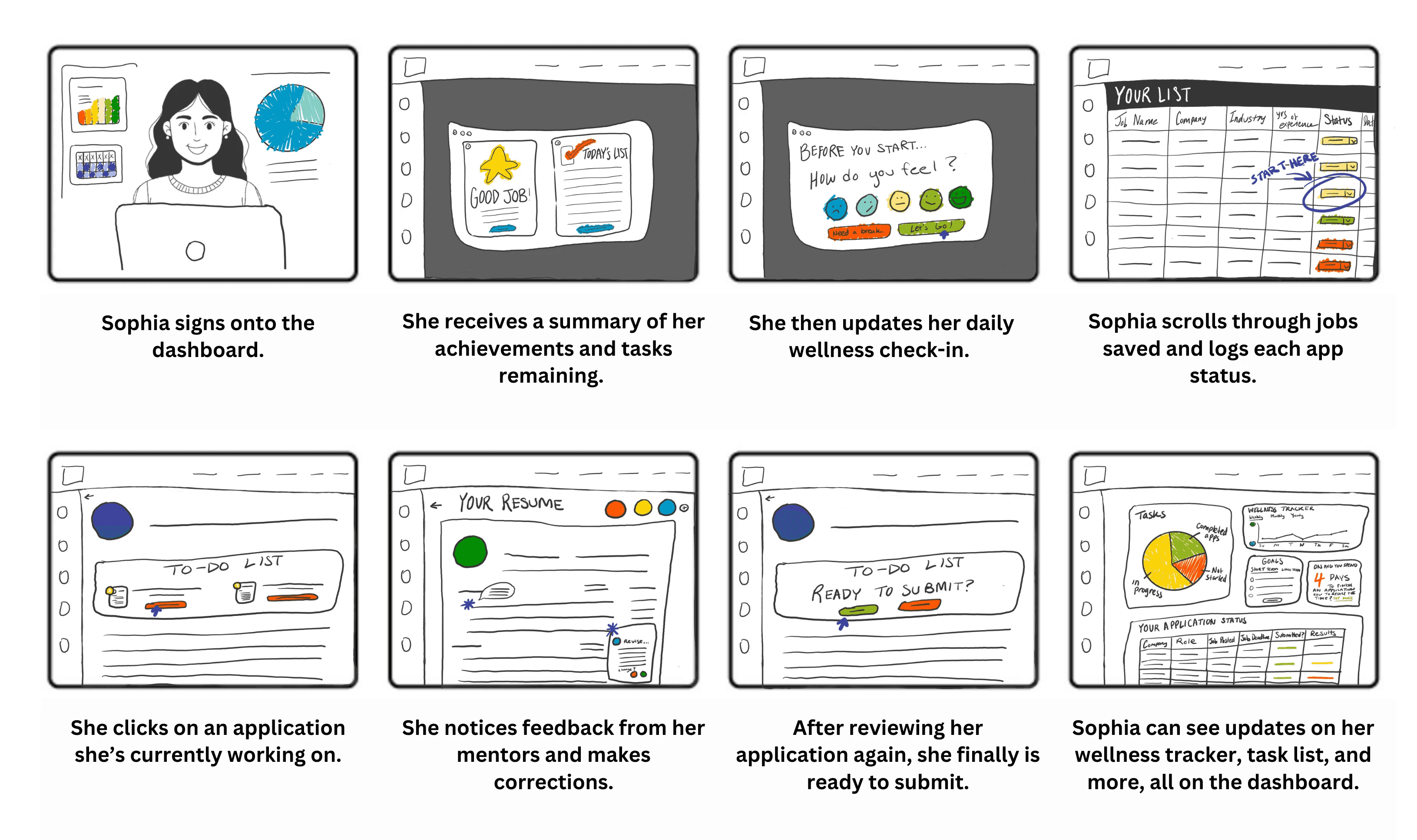
Storyboarding the Customer's Journey
Placing the AI-generated persona in a context scenario helps identify the required actions the platform needs to support for job hunters.
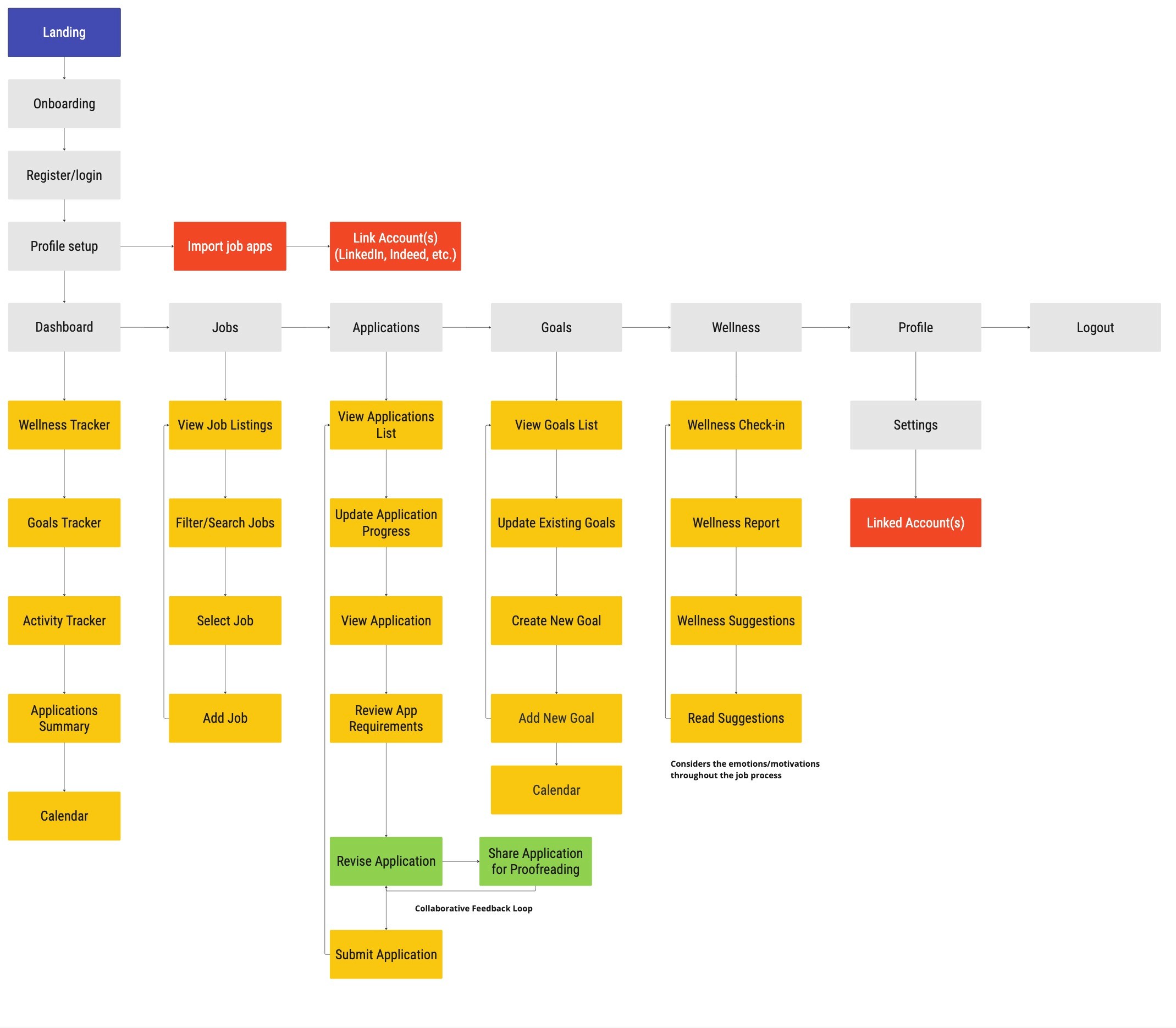
Mapping the Customer's User Flow
With the persona in mind as well as iterations with ChatGPT, a user flow was created to showcase all possible functions that might be necessary throughout the job-seeking experience.
Usability Testing & Feedback
Based on 4 rounds of moderated tests, the feedback gathered helped to improve iterations on creating a visually thoughtful and easy-to-use dashboard. I also made sure to check user testing alongside a generated criteria list to rate their experience, which included ease of navigation, intuitiveness, performance, and more. In addition, to further ensure that all possible scenarios are covered, I prompted ChatGPT to provide 10 possible usability testing simulations to demonstrate the process and to identify 10 possible usability issues given the user personas.
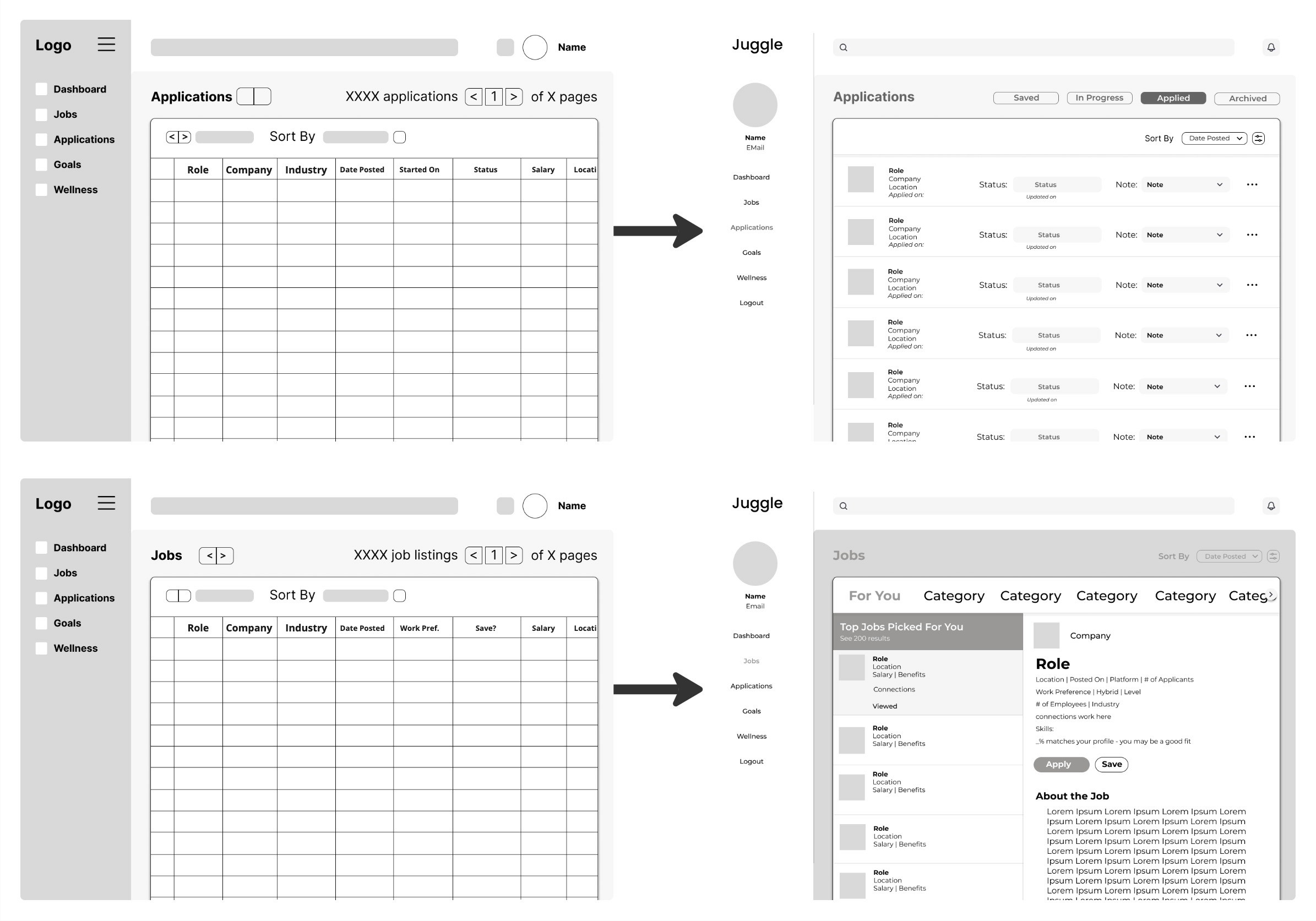
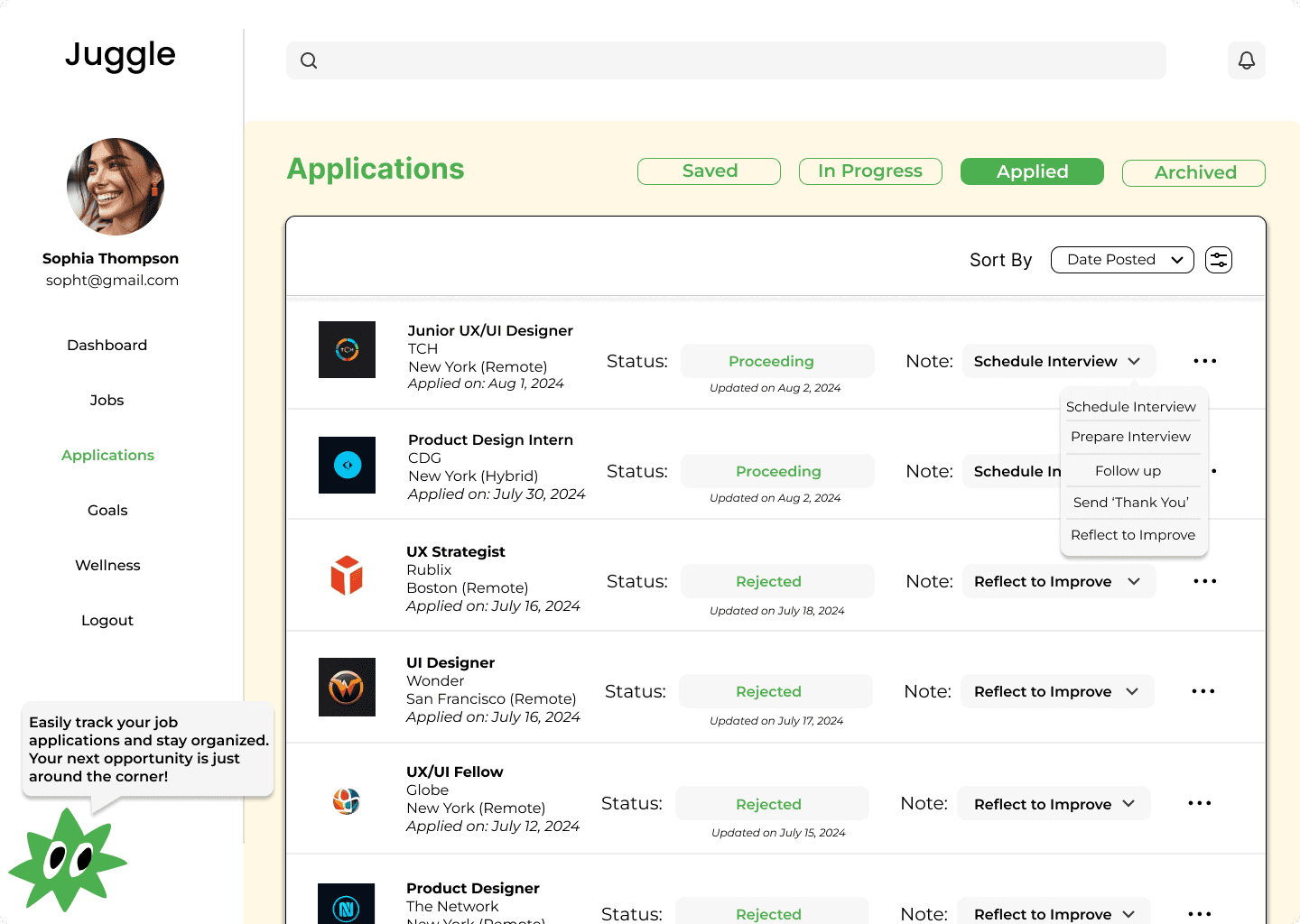
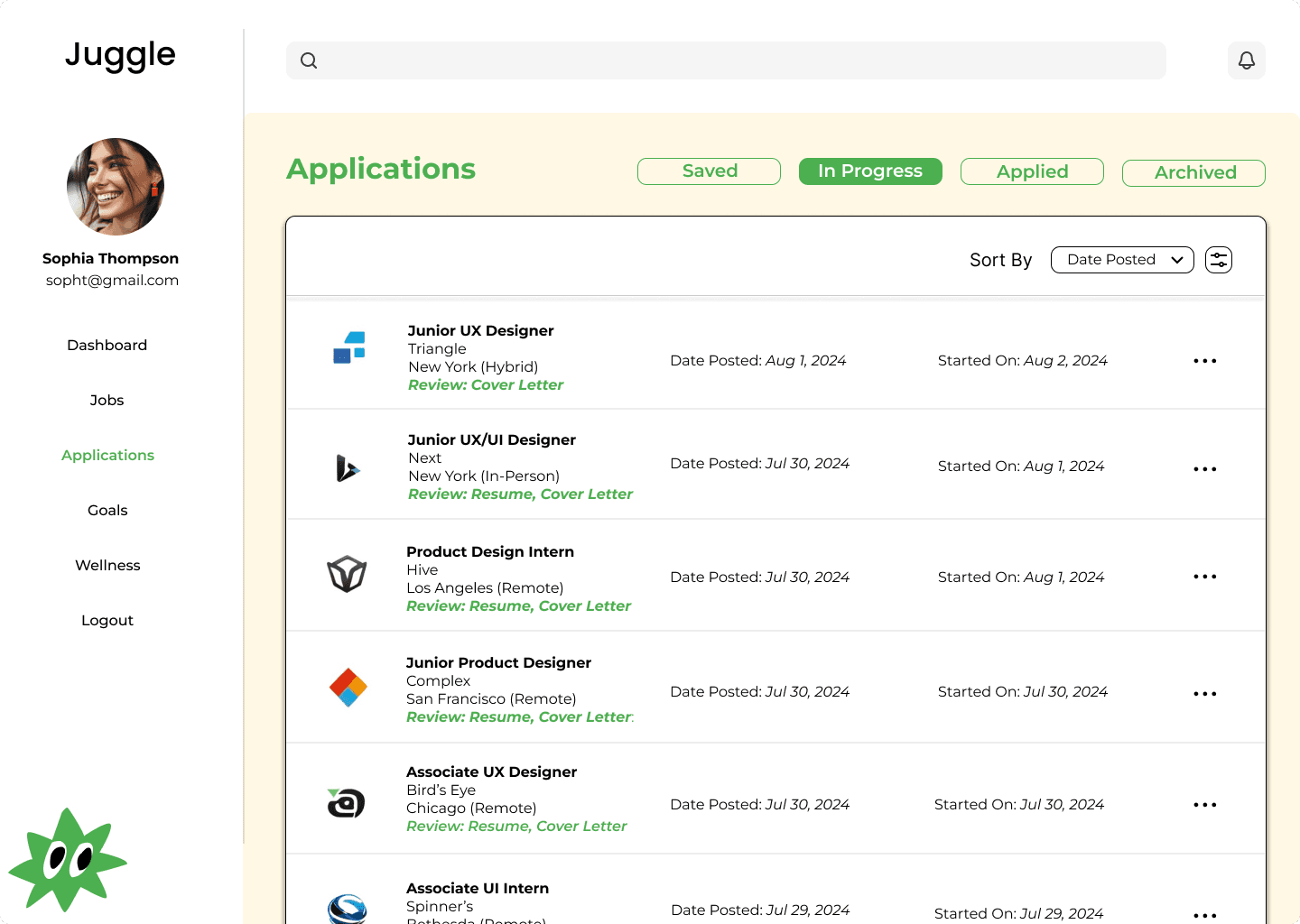
Moving away from an Excel-style format
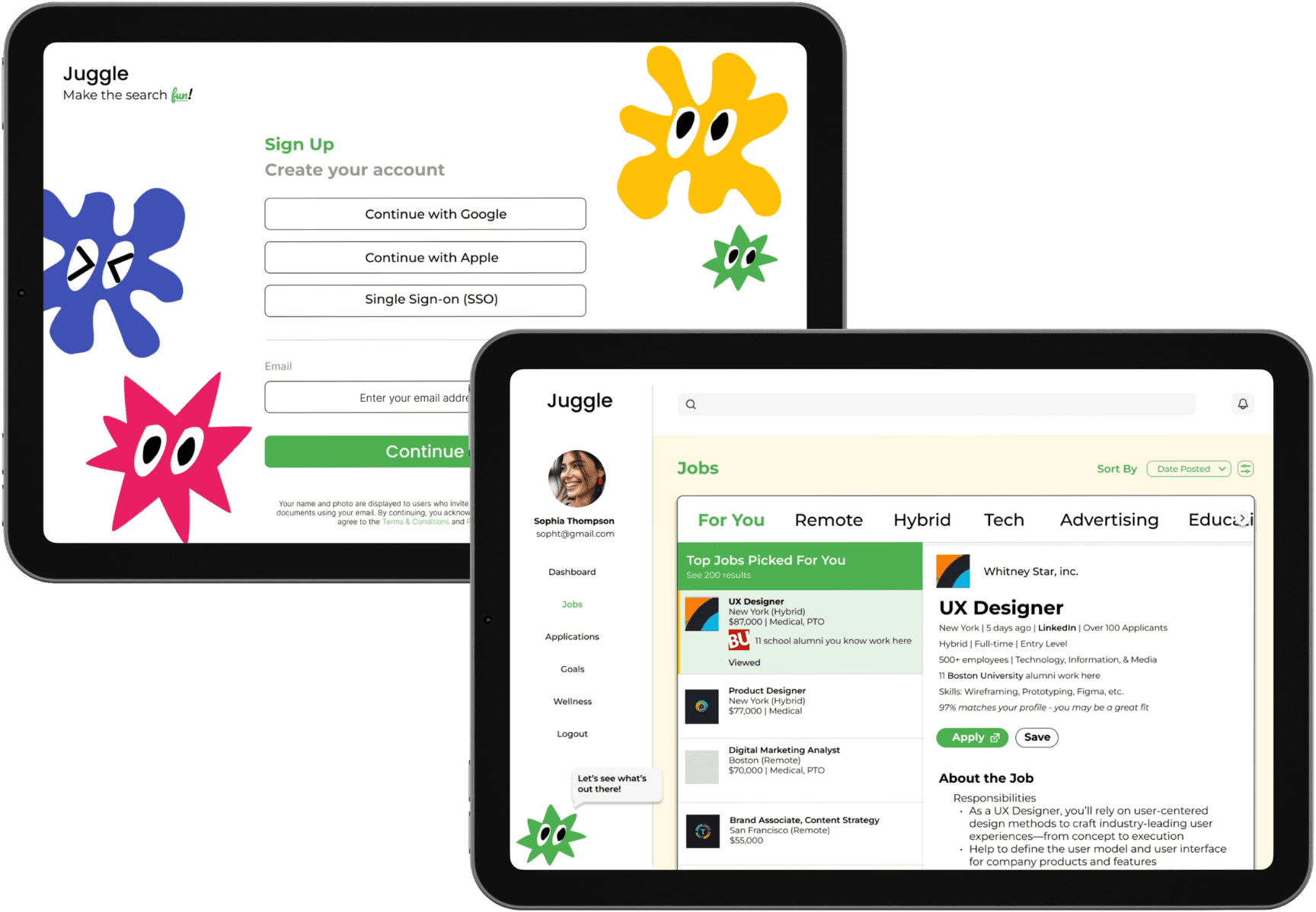
Users expressed that having a list of jobs and applications in the style of a spreadsheet was not comprehensive and would feel a bit overwhelming with information, making it less user-friendly and cluttered. As a result, I reworked the format to be simpler into a list that includes previews of bite-sized information and also gives the user the freedom to decide on which roles to focus on more and take action with.
Moving away from an Excel-style format
Users expressed that having a list of jobs and applications in the style of a spreadsheet was not comprehensive and would feel a bit overwhelming with information, making it less user-friendly and cluttered. As a result, I reworked the format to be simpler into a list that includes previews of bite-sized information and also gives the user the freedom to decide on which roles to focus on more and take action with.
Moving away from an Excel-style format
Users expressed that having a list of jobs and applications in the style of a spreadsheet was not comprehensive and would feel a bit overwhelming with information, making it less user-friendly and cluttered. As a result, I reworked the format to be simpler into a list that includes previews of bite-sized information and also gives the user the freedom to decide on which roles to focus on more and take action with.
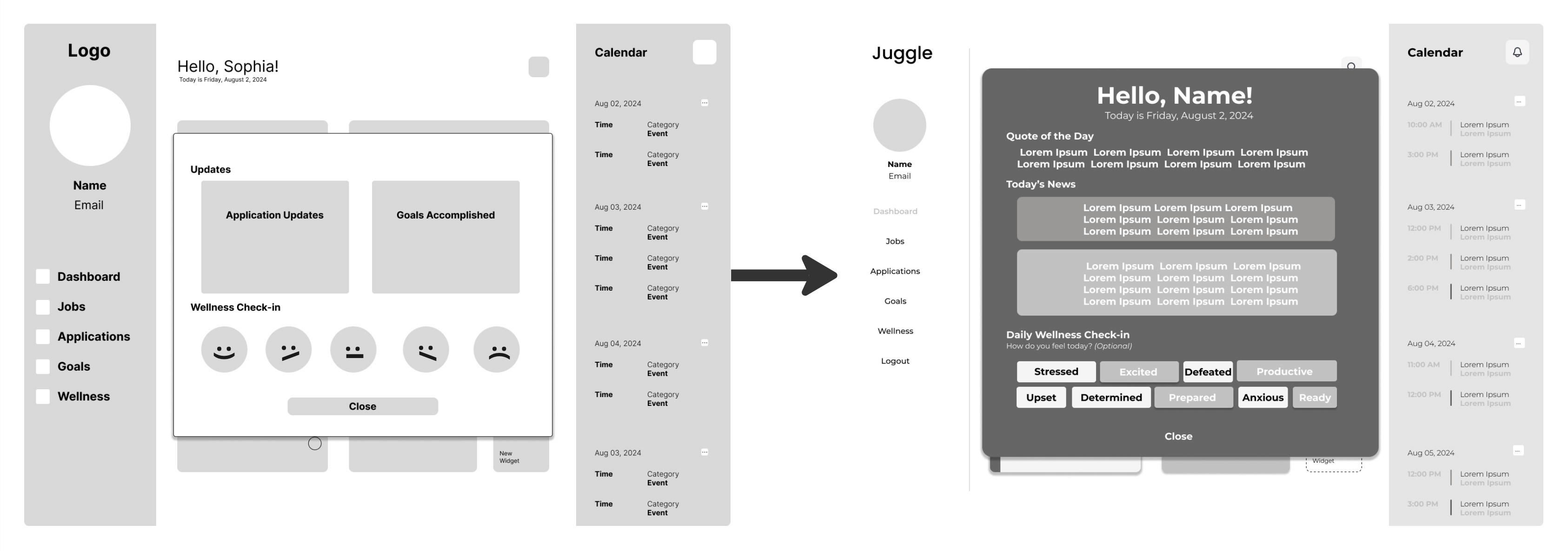
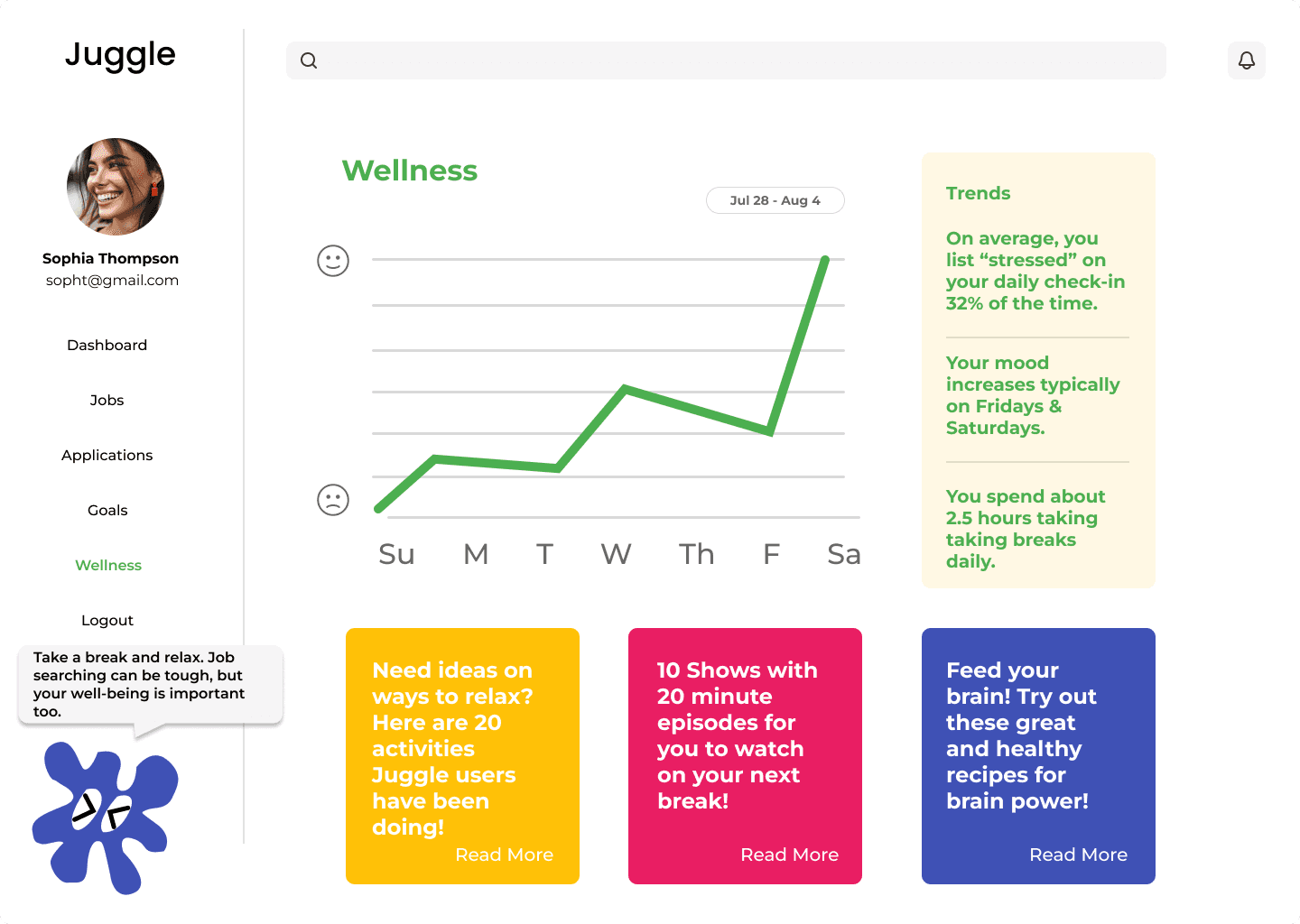
Creating a more personal and refined daily wellness check-in
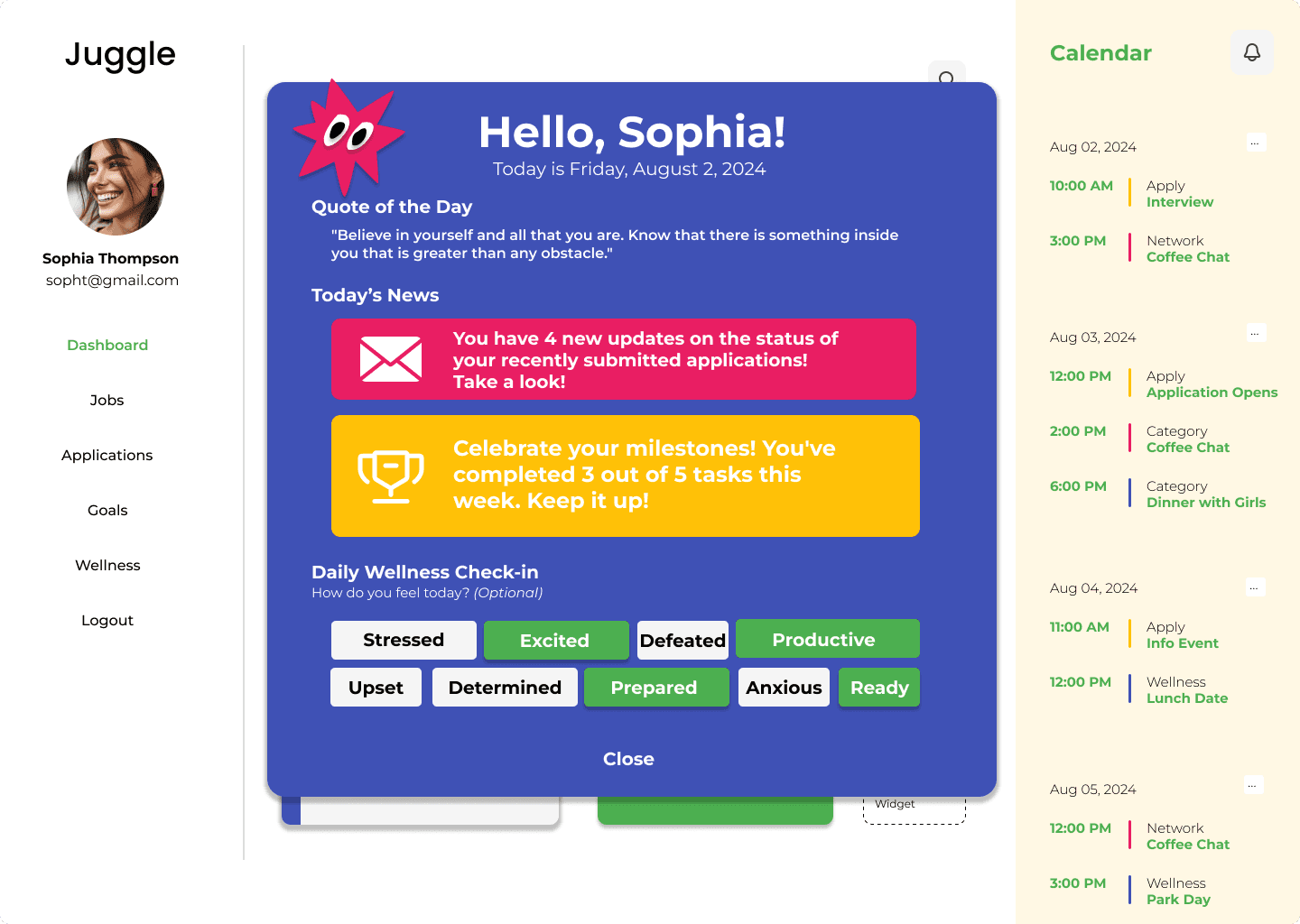
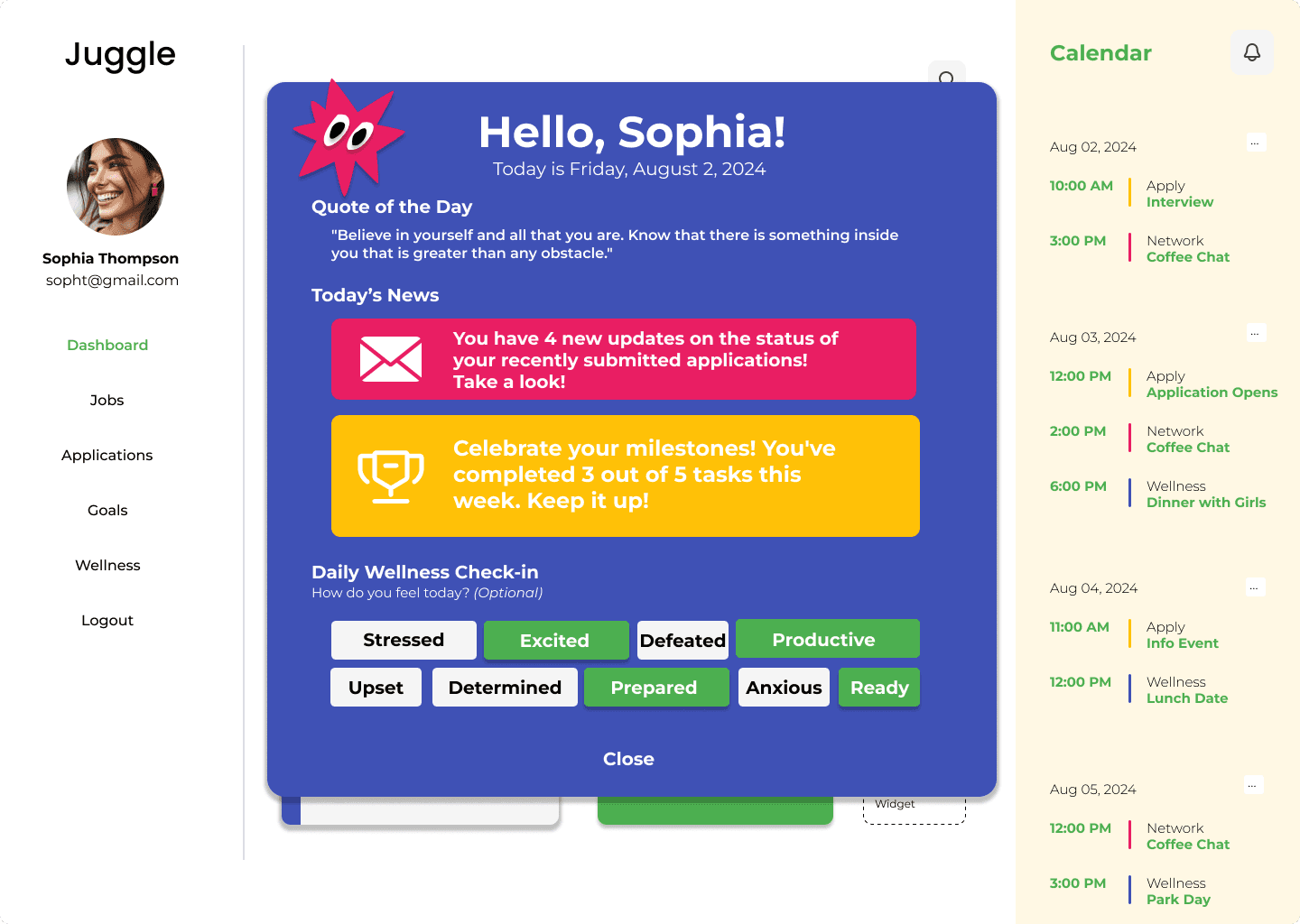
Feedback showed that the well-being features were not personalized enough with a simple happy to sad scale, which would lead to user disengagement. Because of this, I went further in depth with the possible emotions a user could feel throughout the process, and users can select which words best convey their feelings.
Creating a more personal and refined daily wellness check-in
Feedback showed that the well-being features were not personalized enough with a simple happy to sad scale, which would lead to user disengagement. Because of this, I went further in depth with the possible emotions a user could feel throughout the process, and users can select which words best convey their feelings.
Creating a more personal and refined daily wellness check-in
Feedback showed that the well-being features were not personalized enough with a simple happy to sad scale, which would lead to user disengagement. Because of this, I went further in depth with the possible emotions a user could feel throughout the process, and users can select which words best convey their feelings.
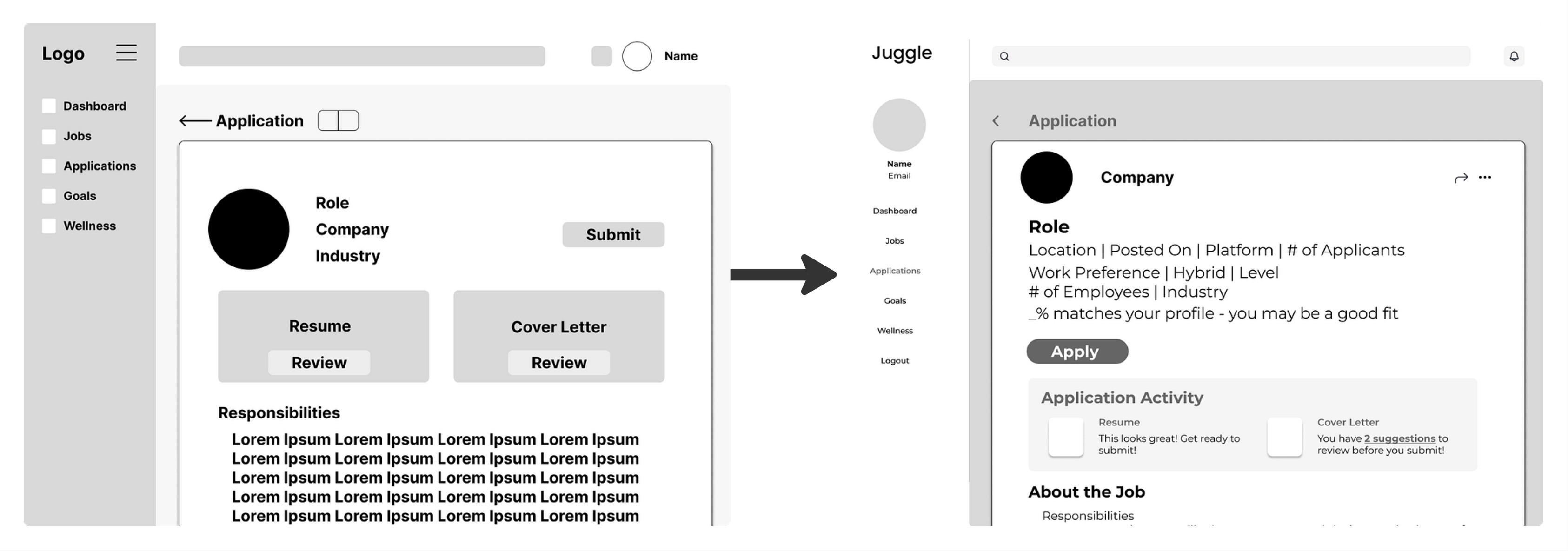
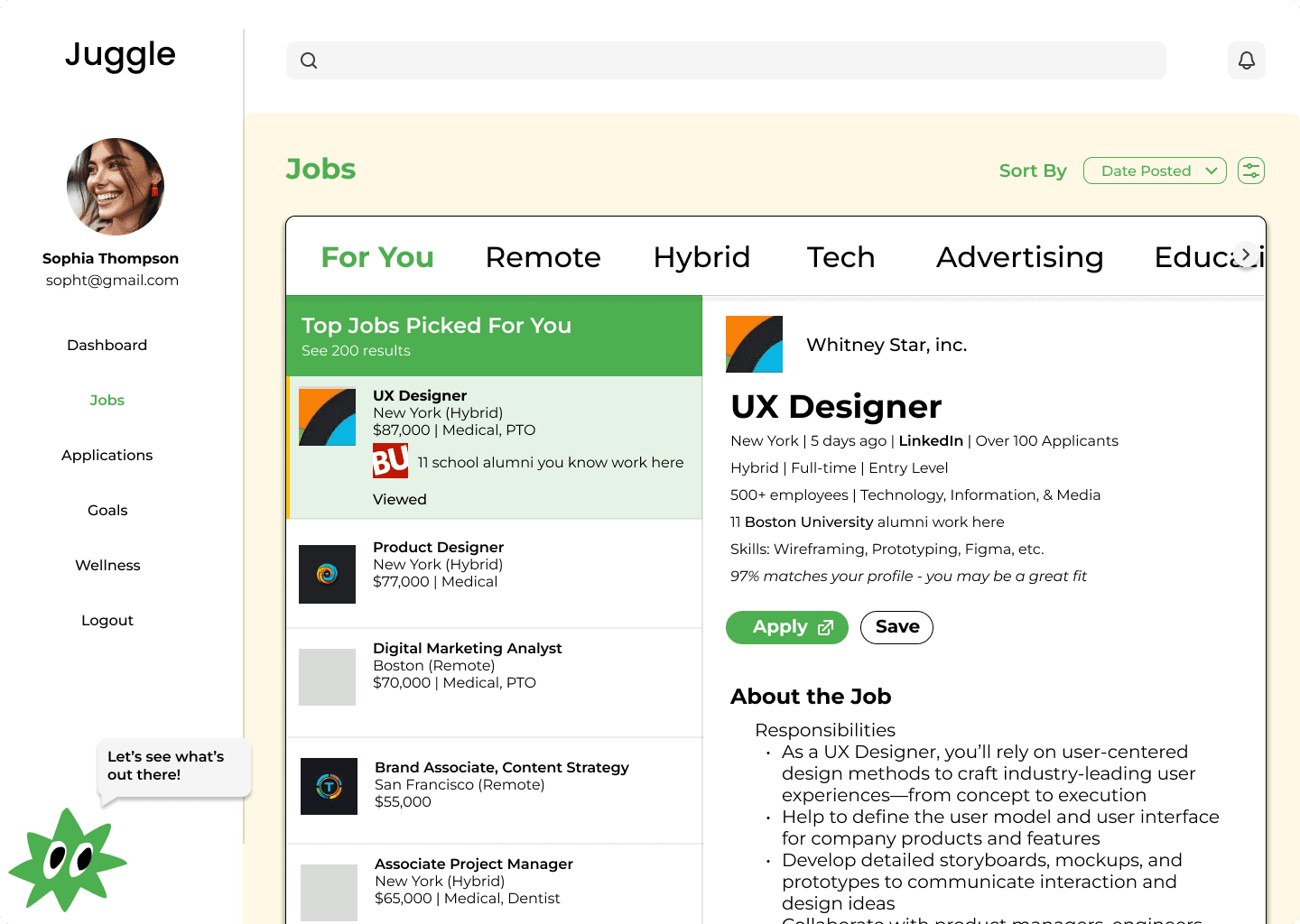
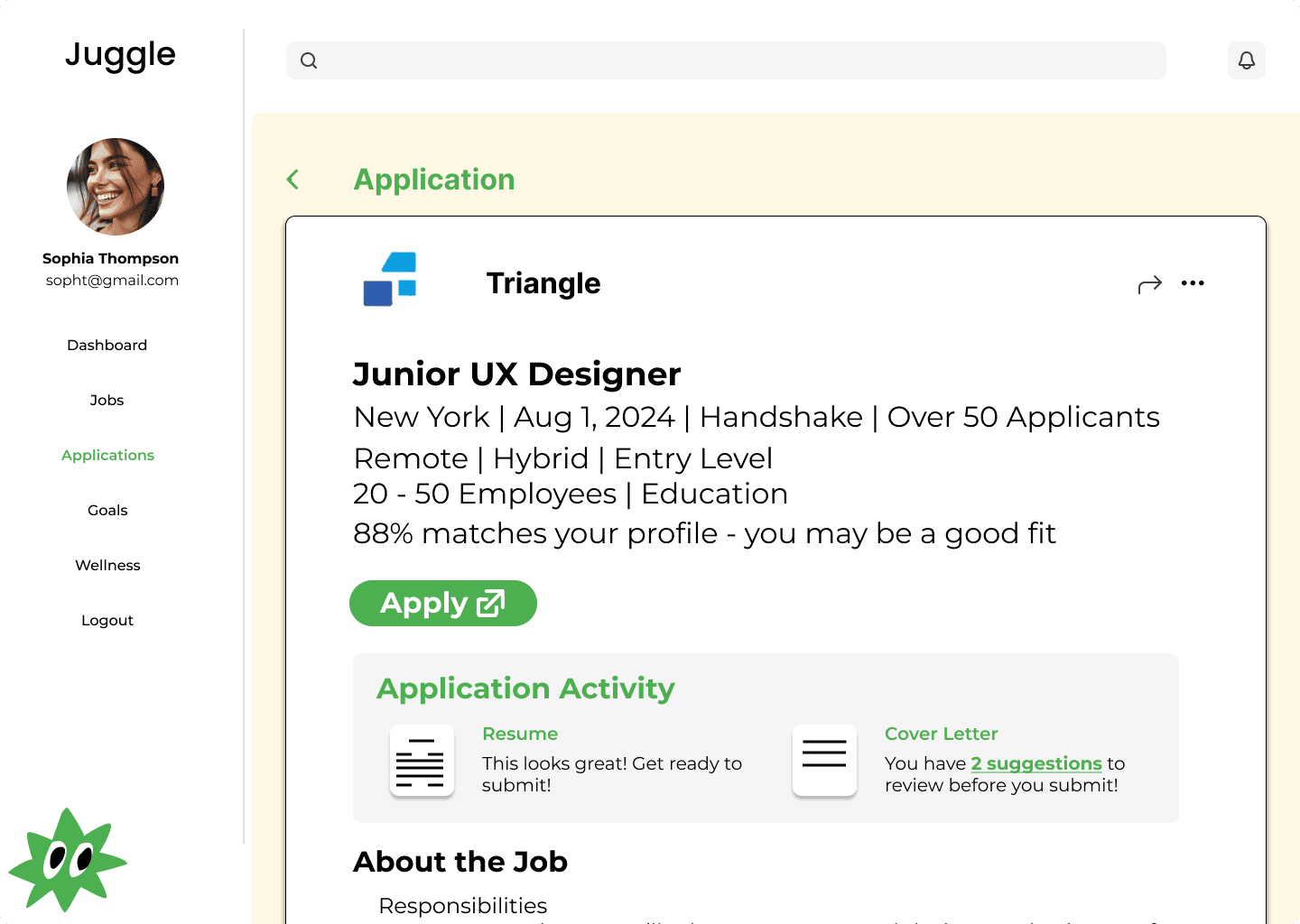
Adding further details on the job profile
A simple job description heading that shows role, company, and industry did not provide enough immediate information for users, and felt that scrolling down for more basic information could deter their attention away from applying. Providing more context to help better inform their decision-making to apply upfront gives more clarity and reduces possible negative experiences during the application process.
Adding further details on the job profile
A simple job description heading that shows role, company, and industry did not provide enough immediate information for users, and felt that scrolling down for more basic information could deter their attention away from applying. Providing more context to help better inform their decision-making to apply upfront gives more clarity and reduces possible negative experiences during the application process.
Adding further details on the job profile
A simple job description heading that shows role, company, and industry did not provide enough immediate information for users, and felt that scrolling down for more basic information could deter their attention away from applying. Providing more context to help better inform their decision-making to apply upfront gives more clarity and reduces possible negative experiences during the application process.
Branding
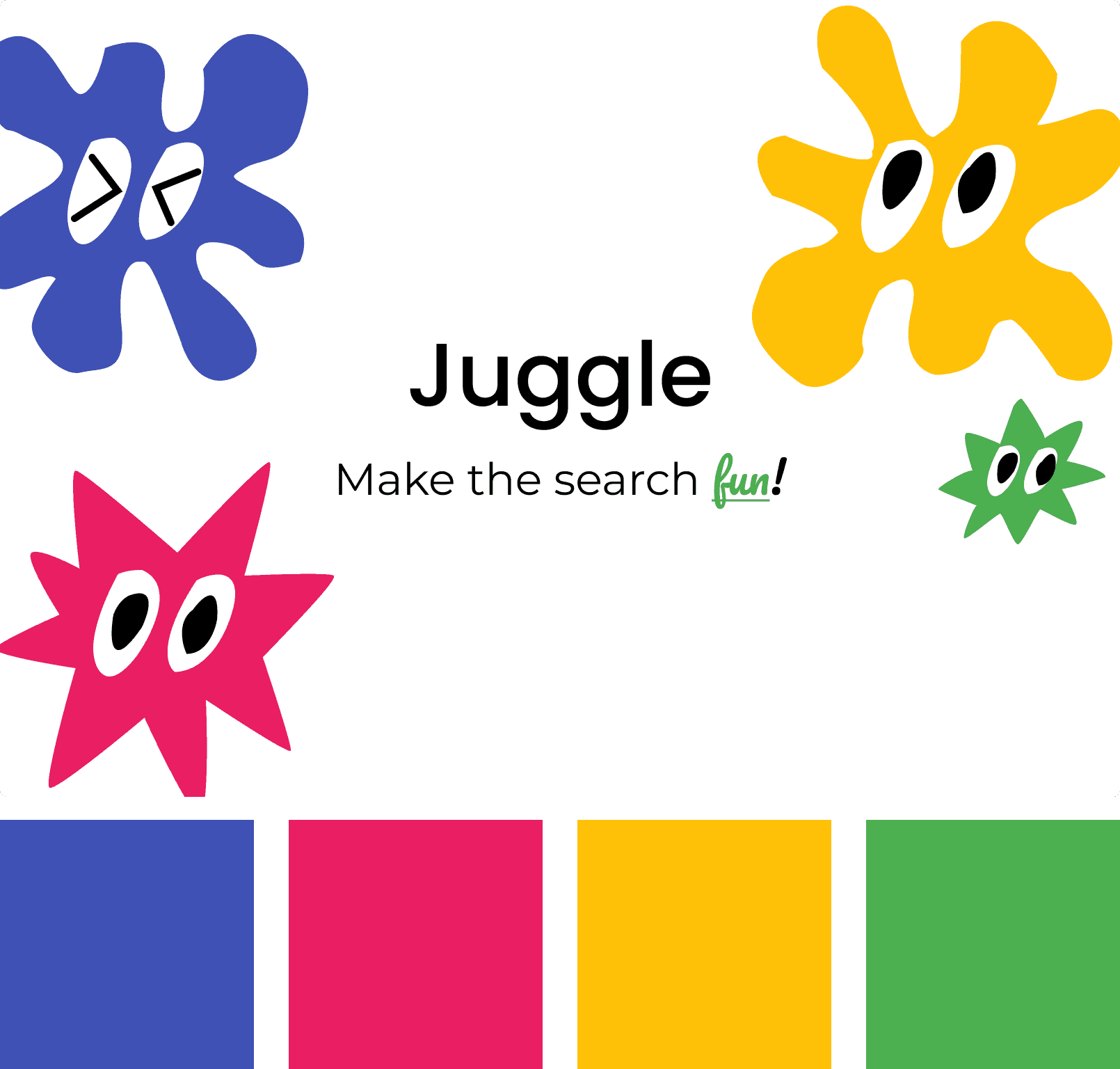
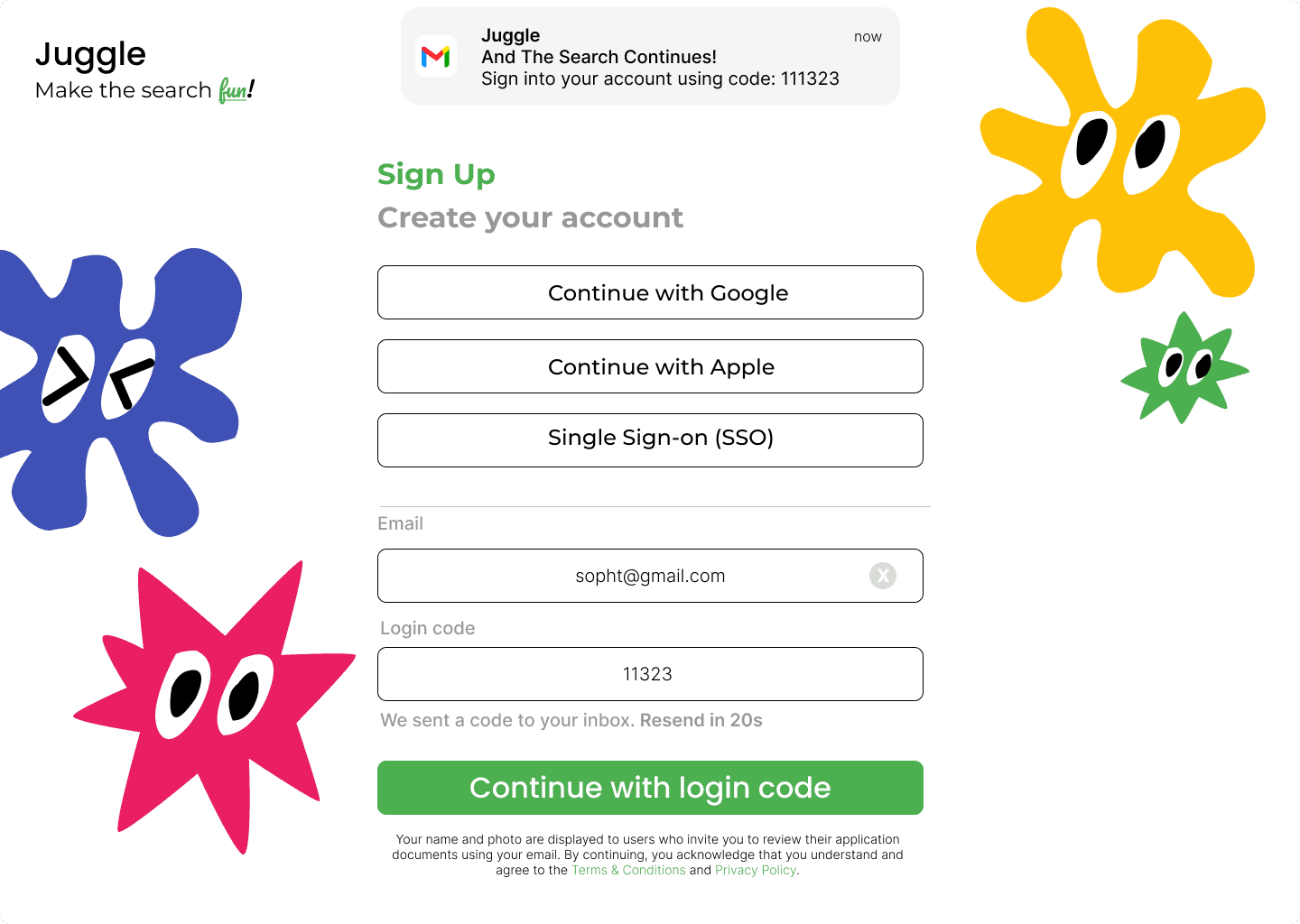
With the slogan, "Make the search fun!", I sought out a branding that could present this message for the dashboard. Prompting ChatGPT for suggestions on different fonts and color styles for branding guidelines, I landed on using Montserrat as the brand font, Poppins for the title, and Pacifico for the accent font. In terms of color styles, I decided green would be best as the main color, alongside amber, indigo, and pink. Moreover, I wanted to incorporate doodle-styled cartoons that would guide users along the journey to add a playful and engaging element to the brand, making the dashboard more relatable and enjoyable for users.
Proposed Solution
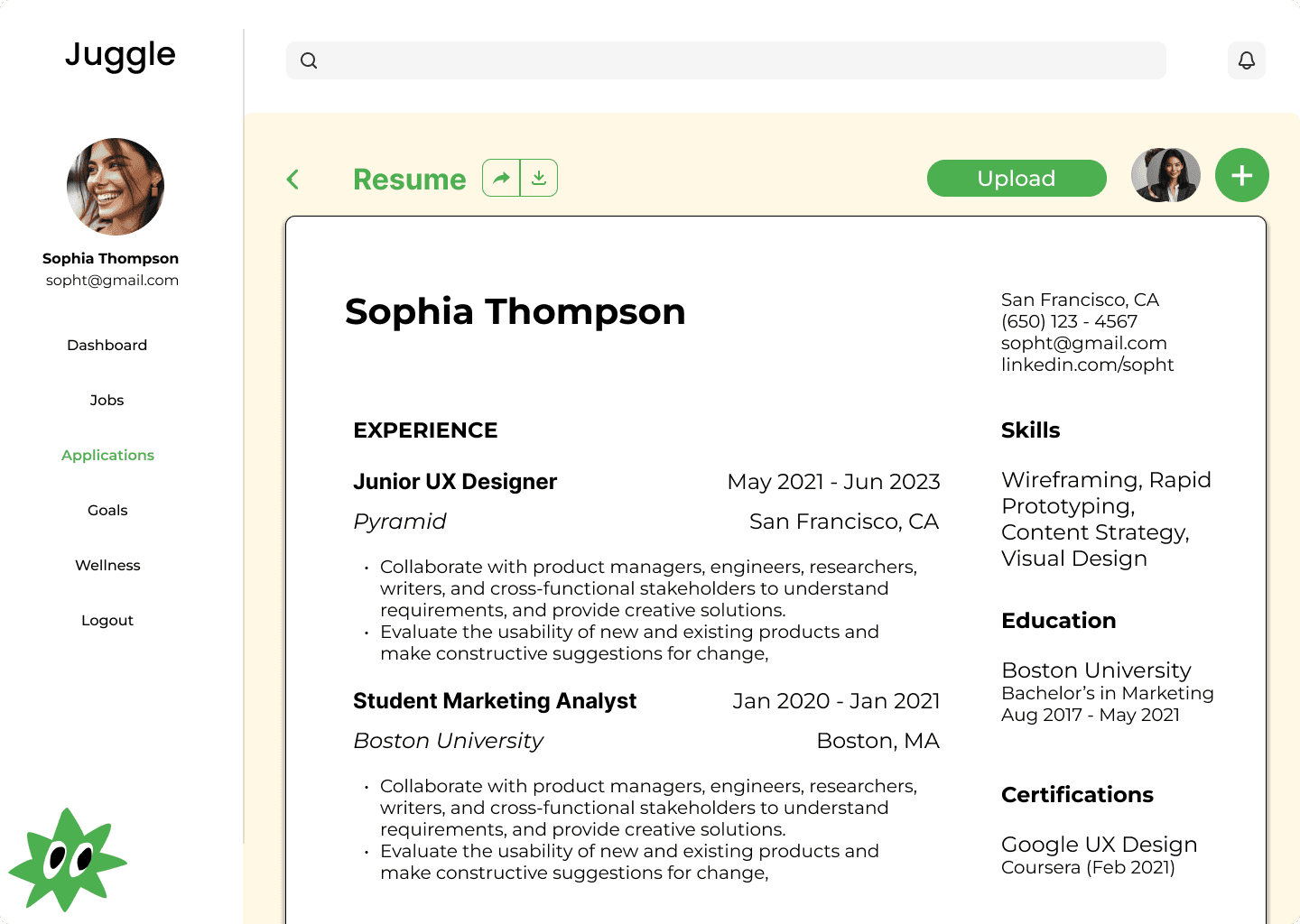
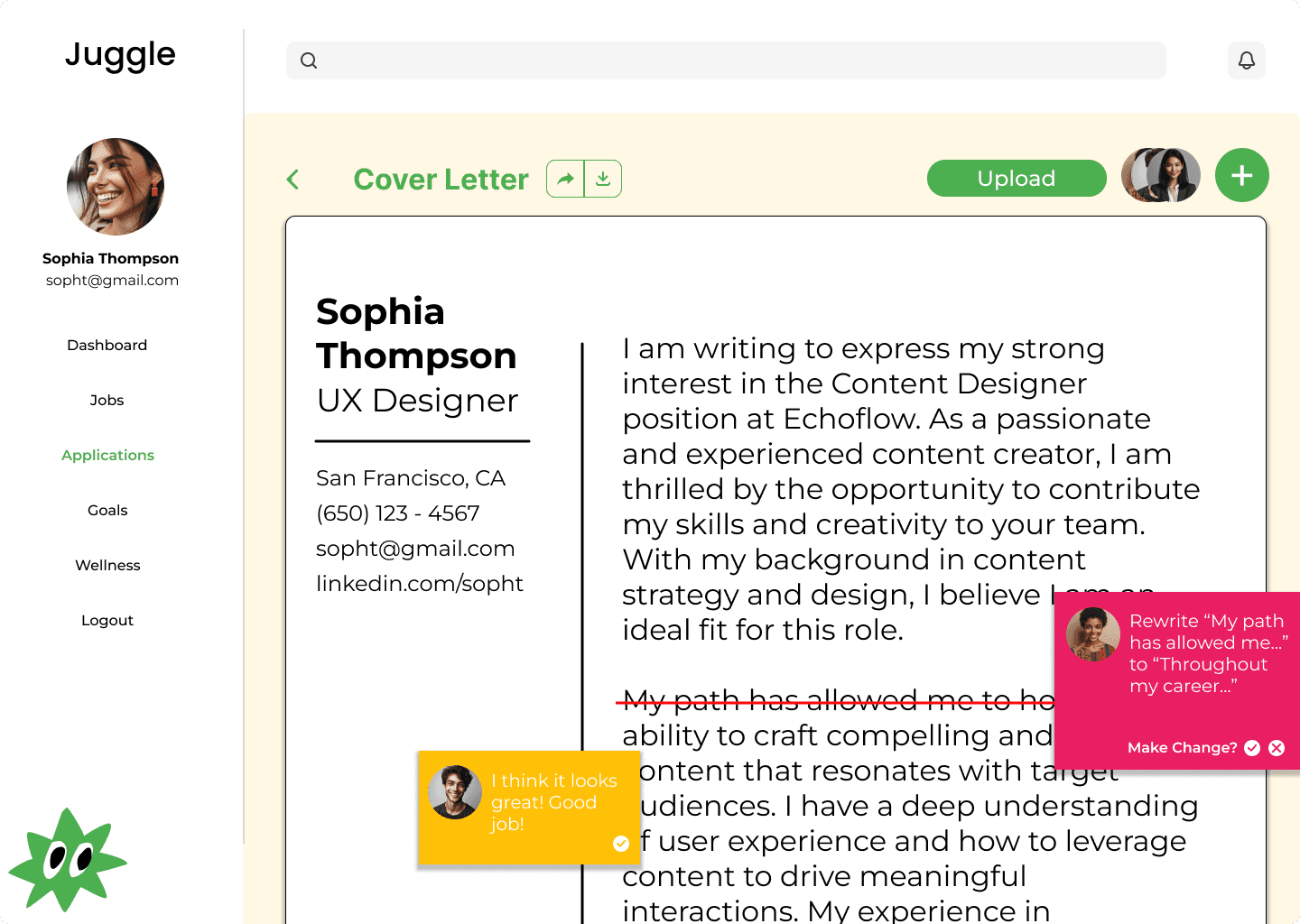
Job Search/Application Tracking
Job Search/Application Tracking
Job Search/Application Tracking
Project Takeaways
The job search can be draining mentally and physically. With how the job market is nowadays, it only makes it more difficult. Collecting my frustrations, I manifested them into this idea in order to cope and navigate with these feelings as well as to further improve on my design skills and apply my newfound knowledge on AI for UED. With more time, I would love to showcase more industry options users can explore as well as demonstrate how AI can help ease the job search. I am proud to see how far I have come from my first case study, and I am excited to see what I come up with next on this journey!